
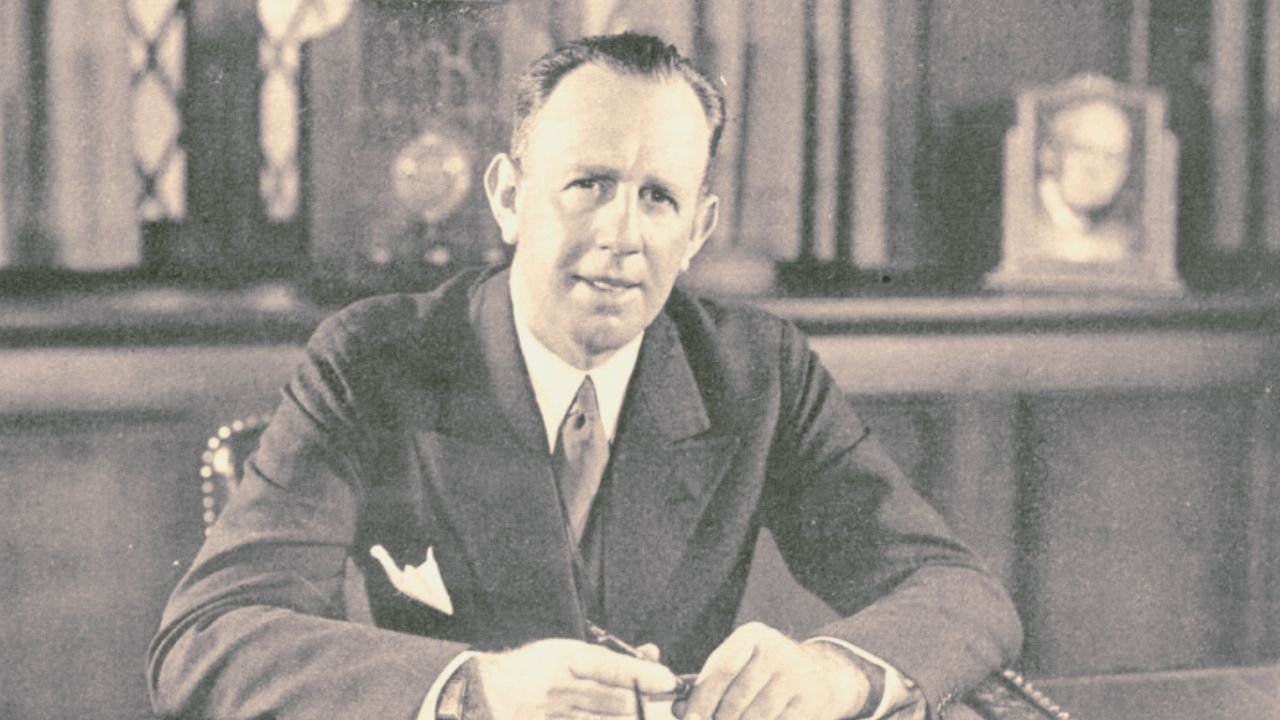
If you have ever searched a genealogy database and come across the name “Powel Crosley,” you might have found more than one result — and wondered which person the record actually refers to. That is a fair question. The name spans at least three generations of a Cincinnati family, and databases do not always make the differences clear.
This article explains who the most prominent Powel Crosley was, how his family connects to the records you might find, and why his career left a mark across so many different fields — radio, consumer products, automobiles, and professional baseball.
The Name “Powel Crosley” and Why It Creates Confusion
The confusion usually comes from one simple fact: the same name was used across multiple generations of the same family.
Powel Crosley Sr. was an attorney based in Cincinnati. He is the father of the man most people are searching for when they look up this name. Powel Crosley Jr. (1886–1961) is the most historically prominent person connected to the name. He was an inventor, businessman, broadcaster, and sports team owner whose work shaped a lot of what ordinary Americans could buy and listen to in the early twentieth century.
Then there is Powel Crosley III, the son of Powel Crosley Jr. He died in 1948, more than a decade before his father passed away in 1961.
When you find a genealogy record attached to this name, check the birth year, spouse, occupation, and location before assuming it refers to any one of them. A record showing 1886–1961 almost certainly refers to Powel Crosley Jr. A record naming an attorney as the father points to Powel Crosley Sr. And a record mentioning a son born in the early 1910s likely involves Powel Crosley III.
Powel Crosley Jr. — Family Background and Early Life
Powel Crosley Jr. was born on September 18, 1886, in Cincinnati, Ohio. His father, Powel Crosley Sr., worked as an attorney. His mother was Charlotte Wooley Utz.
He had a brother named Lewis Crosley, who would later become an important collaborator in his business ventures. Even as young men, the two showed a shared interest in mechanical things. Reports indicate they built a small battery-powered vehicle together — an early sign of Crosley’s lifelong interest in getting people moving affordably.
Crosley attended the University of Cincinnati but left before finishing his degree. He wanted to get into business and was not willing to wait. That impatience, for better or worse, defined a lot of his early career.
In 1910, he married Gwendolyn B. Aiken. They had two children: Powel Crosley III and Martha Page Crosley, who went by the name Page. Powel Crosley III died in 1948, before his father.
From Automobile Accessories to Affordable Radios
Crosley’s early attempts at business were not all successful. He tried several ventures before finding his footing. What eventually worked was automobile accessories.
He built a profitable business through what became known as the American Automobile Accessories Company. Cars were becoming more common, and the accessories market grew alongside them. This gave Crosley a foundation — and capital — to move into something bigger.
His entry into radio came from a personal frustration. He wanted to buy a radio receiver for his son but found the price far out of reach for most families. That was the moment that changed his direction. If radios were too expensive for ordinary households, he reasoned, the solution was to build one that was not.
The result was the Harko receiver, an inexpensive radio set marketed to everyday consumers. The price point was the point. Crosley was not trying to make the most sophisticated radio on the market. He was trying to make one that a working family could actually afford to buy. That approach expanded radio ownership across the United States in a meaningful way.
WLW, the Cincinnati Reds, and a Connected Business Empire
Once Crosley was in radio, he did not stay on the manufacturing side alone. He also got into broadcasting. He founded the Crosley Broadcasting Corporation and operated WLW, a radio station based in Cincinnati.
WLW became a historically significant high-power station with a broad regional reach. It was one of the most recognized stations in the country during its peak years and helped establish Cincinnati as a broadcasting hub. Crosley used it not just as a business but as a platform that connected to his other interests.
One of those other interests was baseball. In 1934, Crosley became majority owner of the Cincinnati Reds. The team’s ballpark was eventually renamed Crosley Field in his honor. And in 1935, Crosley Field became the site of the first night game in major-league baseball history — a moment that changed how the sport was played and watched across the country.
Broadcasting Reds games on WLW was not an accident. It tied his radio station directly to the team and reinforced the Crosley name throughout the region. His businesses supported each other. Radio built visibility. Baseball built loyalty. Together, they made the Crosley name synonymous with Cincinnati life for decades.
Consumer Products and the Crosley Automobile
Crosley’s business interests did not stop at radio and baseball. His company also produced household goods, including refrigerators. One frequently cited innovation is the refrigerator door shelf, which Crosley held a patent for in the early 1930s. It is the kind of practical, everyday improvement that rarely gets much attention — but it is something most people use every time they open a fridge.
He also returned to his original love: automobiles. Crosley Motors began producing small, economical cars in the late 1930s. These compact vehicles were ahead of their time in some ways. They were built for people who wanted basic, affordable transportation — not status. The cars did not dominate the American market, but they represent an early chapter in the history of compact-car thinking in the United States.
It is worth being careful here, though. Crosley’s compact car was not the first small car ever made. It was, however, an early and notable American effort in that direction.
His career followed a pattern that is worth noticing. Each business he built helped fund or promote the next one. Automobile accessories gave him capital. Radio gave him reach. Broadcasting gave him a platform. Consumer products extended the brand into American kitchens. And baseball gave the whole enterprise a public identity that people cared about personally.
For anyone interested in how American consumer culture developed in the early twentieth century, Crosley’s story is a useful case study. You can read more about business figures like him at Start Business Point.
A Quick Timeline for Researchers
- 1886: Powel Crosley Jr. born in Cincinnati, Ohio
- 1910: Married Gwendolyn B. Aiken
- 1910s: Built profitable automobile accessories business
- 1920s: Entered radio manufacturing; launched the Harko receiver; expanded WLW broadcasting
- 1930s: Consumer product growth, including refrigerators; became majority owner of the Cincinnati Reds in 1934; Crosley Field hosted first major-league night game in 1935
- 1939: Crosley Motors began compact-car production
- 1948: Powel Crosley III died
- 1961: Powel Crosley Jr. died in Cincinnati
Tips for Genealogy Researchers
If you are working with genealogy records and the name Powel Crosley keeps appearing, here are a few simple checks that will help you sort out which person you are looking at.
- Compare birth years. Powel Crosley Jr. was born in 1886 and died in 1961.
- Check the listed occupation. An attorney is likely Powel Crosley Sr. An industrialist, broadcaster, or radio manufacturer points to Powel Crosley Jr.
- Look at the spouse. Gwendolyn B. Aiken, married in 1910, is associated with Powel Crosley Jr.
- Cross-reference with census records, city directories, and newspaper archives rather than relying only on compiled family trees, which may not be independently verified.
Generational naming was common in many American families of this era. It creates genuine confusion in databases that do not always flag which generation a record belongs to. Taking the time to compare multiple details will usually resolve the ambiguity.
Why Powel Crosley Jr. Still Matters?
Powel Crosley Jr. was not a household name in the way that entertainers or politicians often are. But his influence reached into American households more directly than most people realize. He helped make radio affordable. He brought night baseball to the major leagues. He patented a shelf that billions of people still use today.
His story is one of practical ambition — a person who kept looking at what people could not afford or access and tried to change that. Whether it was a cheap radio receiver, a compact car, or lights over a ballpark, the through line was the same: make it available to more people.
That is the Powel Crosley the records are most likely pointing to. And now that you know who he was, the records should be a lot easier to read.
Also Read: